 ICT
September 1, 2026
ICT
September 1, 2026
City Of Masvingo signs 20-Year MASTER PLAN, setting the course for inclusive and sustainable development
The City of Masvingo has officially concluded the review of its Master Plan with the signing ceremony marking the beginning of a new 20-year spatial development trajectory aimed at transforming the provincial capital into an inclusive, prosperous and sustainable city aligned with Zimbabwe’s Vision 2030.
The Master Plan signing ceremony brought together the Permanent Secretary for Provincial Affairs and Devolution, Dr Pazvakavambwa councillors, the Town Clerk, Council management, the Lead Planner, government officials, business representatives, residents’ associations, people living with disabilities, the banking sector, transport operators, informal traders, the media and other key stakeholders.
Speaking on behalf of the Minister of State for Provincial Affairs and Devolution, the Permanent Secretary, Dr Pazvakavambwa described the occasion as historic, noting that the Master Plan was more than a planning document, but a 20-year development blueprint that would shape the growth and development of Masvingo.
“Today we have not merely signed a document; we are setting in motion a twenty-year development trajectory that will shape how the City grows, how it serves its people, how it drives the provincial economy, and how it contributes to national aspirations under Vision 2030,” the Permanent Secretary said.
The Permanent Secretary commended the City of Masvingo leadership, Town Clerk, Lead Planner and Council team for successfully concluding the Master Plan review process in accordance with Section 16 of the Regional, Town and Country Planning Act [Chapter 20:12], while also embracing stakeholder participation.
The Master Plan is aligned to National Vision 2030, National Development Strategy 2 (NDS2), sectoral policies and provincial development strategies, providing a spatial framework for future investment in land use, housing, industry, commerce, transport, social services and environmental management.
The Permanent Secretary emphasised that effective implementation of local development plans was critical to translating national aspirations into tangible outcomes.
“Without sound, implementable local plans, Vision 2030 will remain an aspiration on paper,” he said.
As the provincial capital, the City of Masvingo was described as a critical administrative, economic and service hub whose growth has a direct impact on the province’s economy, investment attractiveness, service delivery and overall image.
The Master Plan is expected to support the City’s role in catalysing tourism linked to Great Zimbabwe and the province’s natural heritage, anchoring agro-processing and agribusiness value chains, providing higher-order services and creating a marketplace for goods, labour and innovation.
The Permanent Secretary also highlighted the importance of strengthening the relationship between the City and its surrounding rural districts, particularly through improved transport connectivity, access to markets and services, water resource management, waste management, environmental protection and climate resilience.
The ceremony placed strong emphasis on inclusivity and participatory governance, with stakeholders having contributed to the Master Plan through public meetings, surveys, workshops, sectoral engagements and targeted outreach to vulnerable and marginalised groups.
The Permanent Secretary challenged all stakeholders who participated in the development of the plan to take ownership of its implementation.
“Development is not development if it excludes. A truly developmental city deliberately plans for everyone, every neighbourhood and every livelihood, ensuring that progress is shared,” he said.
The Permanent Secretary called on businesses to align investments with designated industrial and commercial zones, residents to comply with land-use regulations and building standards, informal traders to work with Council to regularise their operations, developers to comply with approved layouts and environmental requirements, and government ministries to align projects with the Master Plan.
He further noted that once approved and gazetted, the Master Plan would have the force of law, making compliance both a legal and developmental obligation.
It was noted that enforcement of the Master Plan should not be viewed as an impediment to development, but rather as a mechanism for protecting investments, residents, public infrastructure and future generations from the consequences of unplanned development.
There was a call for robust feedback mechanisms to support implementation, urging Council to establish and publicise suggestion boxes, hotlines, digital platforms and stakeholder review forums.
“When our people see that their concerns are heard and acted upon, they become more willing to participate; they become partners, not critics,” he said.
The Permanent Secretary further challenged the City to ensure that the national development mantra of “leaving no one and no place behind” is reflected in every aspect of implementation.
He urged Council to continuously assess how developments benefit women, youth, people living with disabilities, the elderly, low-income communities and residents of informal settlements, while ensuring that development is balanced between the city centre, high-density suburbs, peri-urban areas and emerging growth points.
For the Master Plan to achieve its objectives over the next 20 years, the Permanent Secretary called for the establishment of a comprehensive Integrated Results-Based Management (IRBM) framework.
Council was encouraged to develop clear implementation indicators and milestones, report regularly on progress and challenges, integrate Master Plan targets into departmental work plans, budgets and performance contracts, and undertake timely reviews where circumstances require adjustments.
Central Government, through the Provincial Affairs and Devolution Office and line ministries, pledged to support the City in strengthening planning, monitoring and implementation systems.
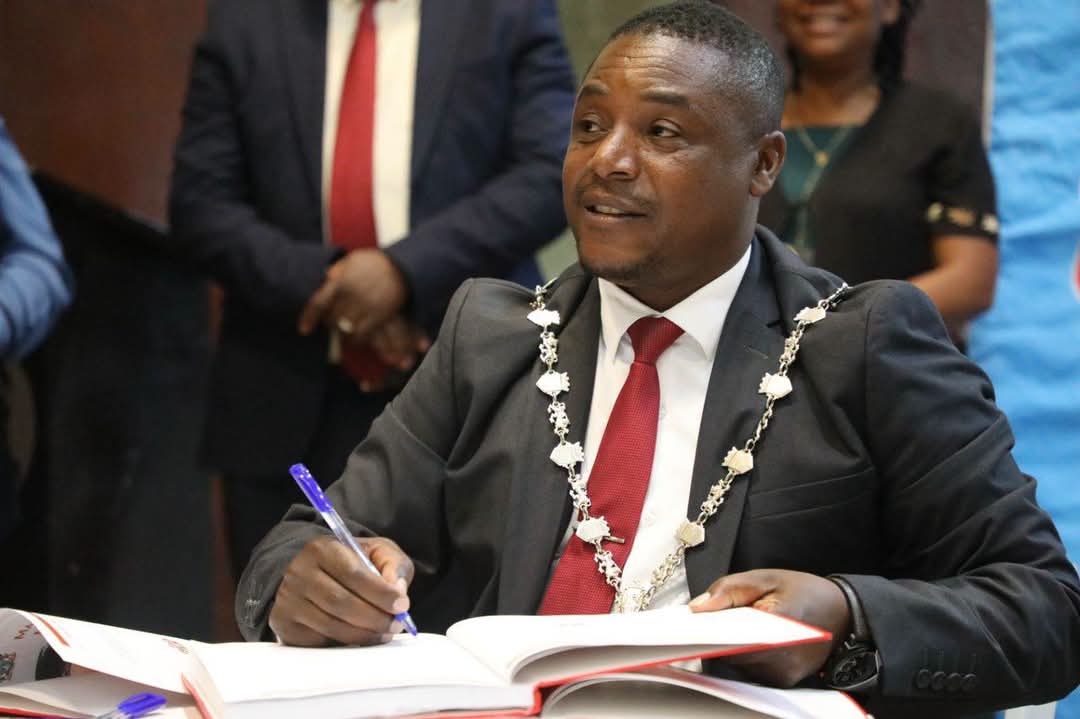
Speaking at the ceremony, the City of Masvingo Mayor, Cllr Aleck Tabe described the signing as a significant milestone marking the transition from the Master Plan review process to implementation.
He acknowledged the contribution of the Town Clerk, Lead Planner, Council management, stakeholders and the wider community towards completing the comprehensive review.
His Worship, the Mayor reaffirmed its commitment to diligently implement the Master Plan and review it regularly to ensure that its provisions remain responsive to changing community needs, economic developments, technological advances and environmental changes.
“Some initiatives will be directly implemented from the Master Plan, while for other provisions, we will proceed to prepare lower-level plans such as local development plans, priority plans, and subject-specific plans,” he said.
The City also called for strengthened partnerships with residents, businesses, government agencies and other stakeholders through public-private partnerships, responsible payment of municipal charges and active participation in municipal governance.
The City of Masvingo’s Master Plan is therefore set to serve as both a legal instrument and developmental blueprint, guiding spatial growth and investment while providing a social contract between Council, Government and the people